Updated May 21, 2026
Three friends texted me the same question this week. PDRN cream or PDRN serum? Which one goes when? And how does it fit with the niacinamide and retinol they’re already using?
Honest short version before we get into it. PDRN serum in the morning under sunscreen, PDRN cream at night for overnight repair. Layer it after niacinamide and hyaluronic acid, never the same night as retinol unless you space them properly. And if you’re picking between the two, your skin type usually decides for you. The rest of this guide is just me walking through what I actually do, what I tell people, and the layering rules that matter. If you want the bigger picture on the ingredient itself, the full PDRN skincare guide covers everything from how it works to why it’s everywhere right now.
Photo by ROMAN ODINTSOV
TL;DR (the box version)
PDRN serum in the morning, layered after niacinamide and under SPF. PDRN cream at night, after a hydrating serum or essence. Both work fine with hyaluronic acid, niacinamide, peptides, and ceramides. Skip the same-night combo with retinol unless you wait 10 to 15 minutes between layers. Patch test first. Pregnancy or breastfeeding? Ask your OB before adding it. None of this replaces a dermatologist’s call on your specific skin.
What’s the difference between PDRN cream and PDRN serum?
Same active. Different vehicle.
PDRN (polydeoxyribonucleotide) is a fragment of DNA, usually pulled from salmon, sometimes plant-derived from ginseng. In topical skincare it’s used to support the skin barrier, soften the look of texture, and calm reactivity. The fish DNA version has more clinical research behind it, mostly from injectable use in clinics. The topical form is a much gentler story than the injectable, and any honest source will tell you that. Topical PDRN works on a more superficial level compared to in-clinic treatments that deliver PDRN directly into the dermis. If you want the full breakdown of how the trend started, the salmon sperm facial breakdown covers the injectable side. Gabriella Sebestyen
So when you see PDRN listed in both a serum and a cream, the molecule is the same. What changes is what carries it onto your skin.
Serum is the thin, water-based one. Lightweight, absorbs fast, lives early in your routine before anything heavier. Most PDRN serums are built for absorption first and hydration second.
Cream is the thicker emulsion. Slower to absorb, sits later in the routine, doubles as your moisturizer. Most PDRN creams pair the active with ceramides, hyaluronic acid, or peptides for barrier support and overnight comfort.
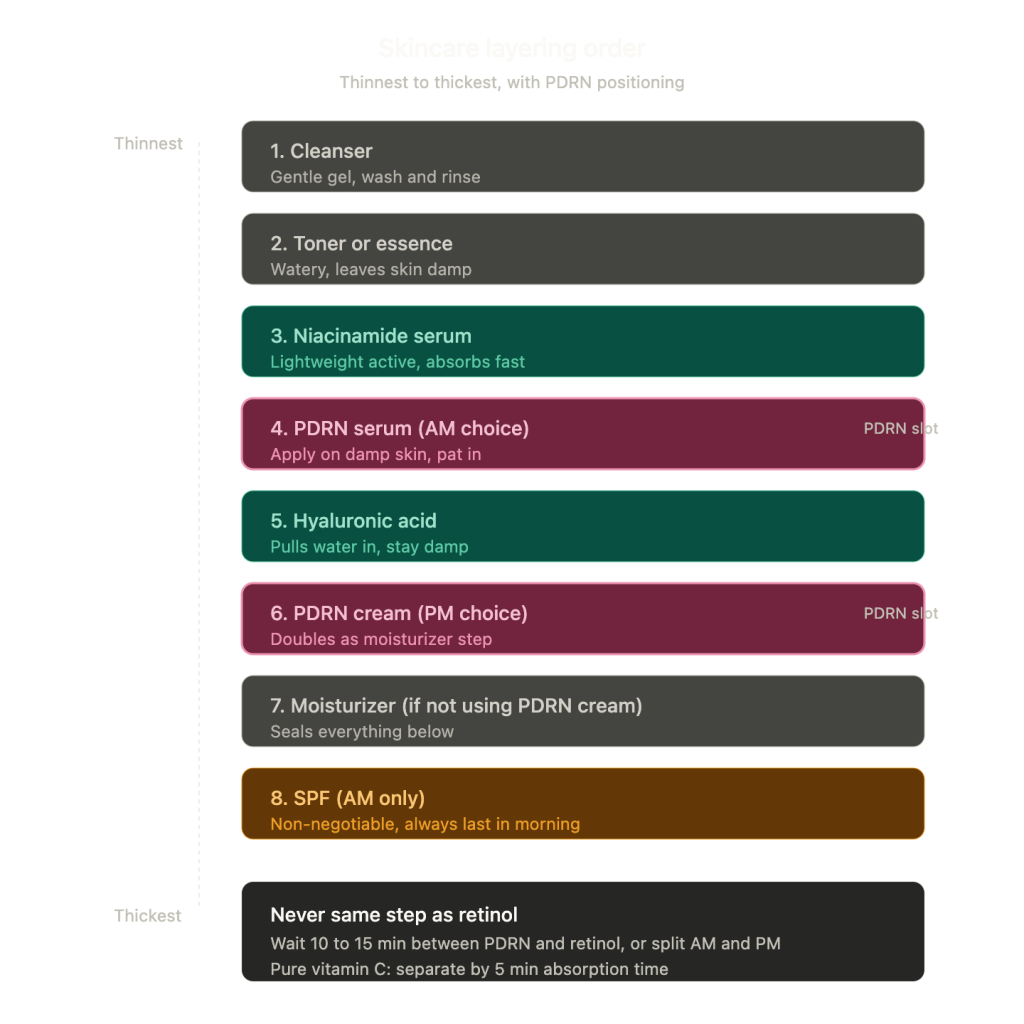
The general layering principle (thinnest to thickest) decides the order for you. Serum first, cream last. But which one you actually need depends on your skin type and the time of day. And honestly, for a lot of people the answer is just one of them, not both.
When to use PDRN serum (and how to layer it)
PDRN serum is the better starting point if your skin is normal, combination, oily, or if you mostly want a glow effect under makeup without adding heaviness to your routine.
It earns its place early in the routine, on slightly damp skin. The general skincare layering principle, apply products from thinnest to thickest consistency, holds for PDRN. A watery essence or toner goes before it, your moisturizer or SPF goes after. PDRNSkinLab
Practical layering order with a PDRN serum:
- Cleanse
- Toner or essence (optional)
- PDRN serum
- Niacinamide serum (if you use one separately)
- Moisturizer
- SPF (AM only)
If you use vitamin C in the morning, that goes before PDRN. Give it about five minutes to absorb so the pH situation settles before you layer anything water-based on top.
A tip I picked up from researching this for friends: damp skin really does help with PDRN absorption. Not soaking wet, just barely damp from your toner. Heavier occlusives applied before PDRN will physically block it from doing much, which is why you don’t pile a thick balm under it and expect results.
For specific product picks, the K-beauty PDRN serums I keep recommending has the full breakdown with price ranges and skin type matches.
When to use PDRN cream (and how to layer it)
PDRN cream is the better fit for dry skin, mature skin, sensitive or barrier-compromised skin, or anyone who prefers a one-step routine over a layered one.
It’s the last actives step before SPF (in the morning) or the last step of the night (at bedtime). A good PDRN cream pulls double duty as your moisturizer, so if you’re already using a heavy cream on top of one, you’re probably layering for no reason.
[Image: Evening PDRN routine flatlay with cleanser, toner, serum, cream, and lip balm on a textured surface. Filename: pdrn-evening-routine-flatlay-2026.jpg. Alt: PDRN evening skincare routine flatlay K-beauty layering guide.]
Practical layering order with a PDRN cream:
- Cleanse
- Toner or essence
- Hydrating serum (HA, peptide, or niacinamide)
- PDRN cream
- Face oil (optional, dry skin)
- SPF (AM only)
One thing to keep honest about. Compared to a serum, the cream format slows how fast PDRN reaches the deeper layers. The emollients and occlusives that make a cream a cream are great for sealing in moisture, less great for pushing actives down. A well-formulated PDRN cream from a reputable manufacturer will still deliver meaningful active ingredient to the skin. The absorption profile is simply different from a serum. Translation: if absorption is the priority, lean serum. If comfort and overnight repair is the priority, lean cream. Pdrnscience
My morning routine with PDRN
What works for me in the morning is the lighter version of the routine. I’m not running a glass-skin laboratory before work.
- Cleanse with a gentle gel cleanser
- Toner for a quick hydration layer (skip if running late, I’m not precious about it)
- PDRN serum on damp skin, a few drops, patted in
- Moisturizer (some weeks this is just a basic ceramide cream, some weeks I’m testing something K-beauty)
- SPF (the non-negotiable one)
The PDRN serum sits right in the absorption window between toner and moisturizer, which is where it works best. I don’t combine it with retinol in the morning, and I don’t layer vitamin C right on top of it unless I’ve given the C five minutes to absorb first.
My evening routine with PDRN
Evenings are where I lean cream over serum, especially when my skin feels tight or I’ve been outside too long in heating or cold weather.
- Double cleanse (oil first, then a gentle foaming cleanser)
- Toner or essence
- Hydrating serum (HA or niacinamide depending on what I’m focused on that week)
- PDRN cream as my moisturizer step
- Eye cream and lip balm last
When I’m using retinol, I move PDRN cream to a different routine entirely. More on that in a second.
How PDRN works with niacinamide and HA
This is the section three of my friends actually wanted, so I’m spending real time here.
PDRN, niacinamide, and hyaluronic acid are a great trio. None of them fight each other, all three target different parts of the same problem (barrier strength, hydration, tone), and the layering order is pretty forgiving as long as you go thinnest to thickest.
Order on damp skin: toner → niacinamide serum → PDRN serum (or cream as the moisturizer step) → HA, or HA inside the cream itself.
A 2022 study that pops up in basically every PDRN article looked at PDRN, niacinamide, and vitamin C together, and the three-ingredient combo outperformed any single ingredient on skin tone evening. The takeaway isn’t “always use all three.” It’s that these ingredients are friendly together, not competitive.
Hyaluronic acid wants damp skin to actually pull water in. PDRN also performs better on slightly damp skin. So both ingredients want the same condition, which makes the order forgiving. I usually do PDRN first on damp skin, then HA on top while it’s still tacky, then a moisturizer to seal both. If you want a cleaner walkthrough of the HA side specifically, our niacinamide vs hyaluronic acid layering guide covers the order question on its own.
If you’re also working with retinol, the niacinamide and retinol layering rules cover the wait times that keep your barrier happy.
When NOT to layer PDRN
A short list. These matter more than the routine itself, honestly.
Same routine as retinol without spacing. This is the most common mistake. Retinol applied straight on top of PDRN, or vice versa, increases irritation and can interfere with both. The protocols in this guide exist because PDRN’s benefits are real, but only when the ingredient can actually reach the skin layers where it works. The safer version is PDRN on damp skin, wait 10 to 15 minutes, then retinol on dry skin. Or split them: PDRN in the morning, retinol at night. SeoulCeuticals
Right after AHA or BHA exfoliation. Wait at least 15 to 20 minutes after an acid step before applying PDRN, ideally on a different night entirely if your skin is reactive.
With pure ascorbic acid vitamin C in the same step. A few sources flag that vitamin C in acidic forms can destabilize PDRN. Separate them by time: vitamin C in the morning with at least five minutes of absorption time before anything else, PDRN later in the routine or in the evening.
On active acne, open wounds, or broken skin. PDRN isn’t recommended on actively inflamed acne or compromised skin. Heal first, treat second.
During pregnancy or breastfeeding. This is where I’m most careful. There’s not enough research to confirm its safety for pregnant and breastfeeding women, and that’s the honest truth even though brands like The Inkey List market their plant-based PDRN as pregnancy-safe. Talk to your OB or your dermatologist before adding it to your routine if you’re pregnant or nursing. Don’t take a brand’s marketing copy as medical clearance. Vogue
If you have a fish allergy. Most PDRN is salmon-derived. Check the ingredient list (look for Sodium DNA or salmon DNA), confirm with the brand if you’re unsure, and patch test. Plant-based vegan PDRN versions exist if you want to skip the question entirely.
One more general note. The injectable PDRN procedure that you’ll see on TikTok branded as “salmon sperm facials” is a separate thing from the cream and serum you can buy. The injectable form isn’t FDA-approved in the US for cosmetic use, and topical PDRN cream or serum is not a substitute, doesn’t replicate the same effect, and shouldn’t be marketed as one. Anything I say in this guide is about the topical cosmetic version only.
Best PDRN cream picks for 2026
A short list of creams that are actually available in US retail right now, with prices that aren’t insulting. None of these are affiliate links because this site doesn’t run them. I’m just telling you what I’d point a friend toward.
Anua PDRN Hyaluronic Acid 100 Moisturizing Cream – $24 at Ulta. Blends low-molecular PDRN with hydrolyzed collagen, ten types of hyaluronic acid and niacinamide. Fragrance-free, layers well under makeup. Good entry point if your skin is normal to combination and you want PDRN as your everyday moisturizer step. YesStyle
Medicube PDRN Pink Collagen Capsule Cream – around $40 at Ulta and Target. The dual-texture pop-the-capsule format. Good for normal to dry skin, has a niacinamide co-star, and works fine under makeup. The texture takes a second to get used to but it absorbs cleanly.
VT Cosmetics PDRN Cream 100 – $26 at Ulta. This one uses plant-derived PHYTO PDRN from wild ginseng instead of salmon DNA, so it’s the option if you want to skip the fish-derived version. Pairs well with sensitive skin and works fine if you’re still introducing PDRN slowly.
VT Cosmetics PDRN Capsule Cream 100 – $20 at Ulta. Cheapest of the bunch, also plant-derived. Solid budget entry if you’re just testing whether PDRN actually agrees with your skin before going deeper.
Best PDRN serum picks for 2026
I’m keeping this short because the serum picks live in their own guide with more detail. The three I’d point friends toward:
Medicube PDRN Pink Peptide Serum for combination skin and a glow finish under makeup.
Anua PDRN Hyaluronic Acid 100 Capsule Serum for normal to dry skin that wants more cushion.
The Inkey List PDRN Serum for the plant-derived option at an entry-level price.
FAQ
Should I use PDRN cream or PDRN serum? If your skin is dry, mature, or barrier-compromised, the cream is usually the better single product. If your skin is combination, oily, or you want PDRN early in a multi-step routine with other actives, the serum is the better fit. There’s no rule that says you need both.
Can I use PDRN cream and PDRN serum together? Yes. Apply the serum first on damp skin, give it a minute, then the cream. You’re not doubling the active in any meaningful way, but the cream still functions as your moisturizer step. Most people don’t need both, but it’s safe to layer if you want to.
When do you apply PDRN cream in your routine? Last actives step. After cleanser, toner, and any thinner serums (PDRN serum, niacinamide, HA), and before SPF in the morning. Treat it as your moisturizer step.
Can you layer PDRN with retinol? Yes, but with spacing. The safer approach is PDRN on damp skin, wait 10 to 15 minutes, then retinol on dry skin. Or split them entirely (PDRN in the morning, retinol at night). Applying them back to back without a wait increases irritation and reduces both actives’ effectiveness.
How long does it take to see results from PDRN cream? Hydration and a softer surface feel show up in the first week or two. Anything more structural (firmness, evened tone) takes longer, typically 6 to 12 weeks of consistent daily use. And honestly, topical PDRN gives gentler results than the injectable form. If you’re expecting dramatic transformation from a cream, you’ll be underwhelmed. Expect calmer, plumper, better-hydrated skin, not a clinic-grade overhaul.
Is PDRN cream safe during pregnancy? There isn’t enough research to give a confident yes or no. Some brands market plant-based versions as pregnancy-safe, but the broader dermatology consensus is to ask your OB or dermatologist before adding it during pregnancy or breastfeeding. None of this is medical advice, and pregnancy ingredient decisions belong with your doctor, not a beauty blog.
Conclusion
The short version of all this. Serum if your skin is on the lighter or combination side, cream if it’s drier or more reactive, both if you really want, neither in the same step as retinol or pure vitamin C without spacing.
If you’re still picking which product to start with, the full PDRN skincare guide has the bigger ingredient picture, and the K-beauty serum roundup covers the specific product side in more depth. Anything more specific to your skin (especially if you’re pregnant, post-procedure, or dealing with reactive skin) is a dermatologist conversation, not a beauty blog one.
If you found this guide useful, send it to the friend who’s been texting you the same PDRN question. That’s how I ended up writing it in the first place.