What a Salmon Sperm Facial Actually Is
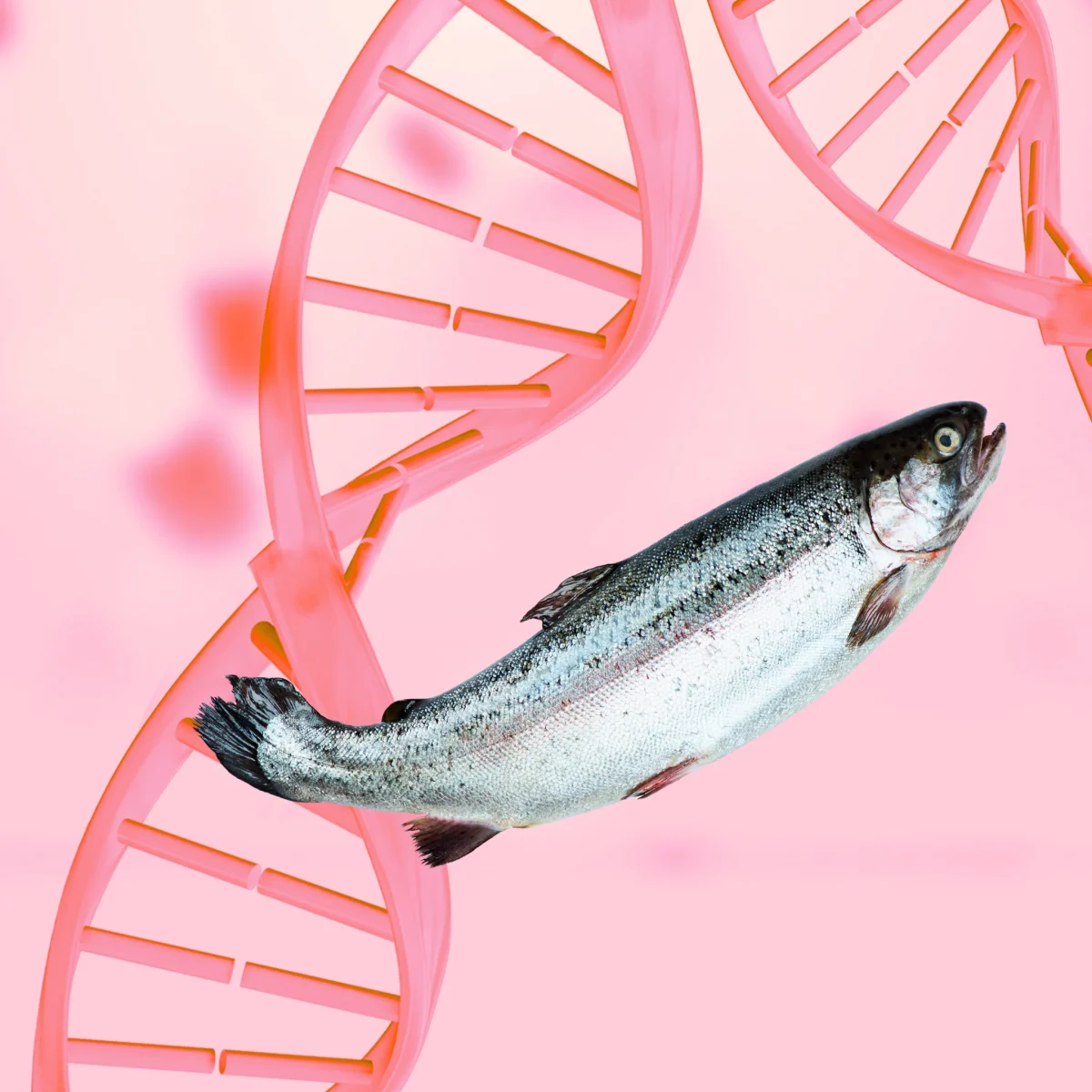
Let me clear up the name first because everyone gets stuck here. No one is putting actual fish sperm on your face. The active ingredient is PDRN – polydeoxyribonucleotide. The supposed skin rejuvenating ingredients are breakdown fragments of DNA known as polydeoxyribonucleotides. These are produced by subjecting DNA extracted from salmon sperm to certain enzymes.
The reason salmon DNA gets used is boring and biological: it has high similarities with human DNA, making it biocompatible for injecting into the skin and suitable for supporting skin regeneration. Any DNA technically works. Salmon milt is just abundant and easy to source.
When PDRN is delivered into the skin, it does a few things. According to a peer-reviewed PDRN clinical review on PubMed, PDRN’s dermatological applications include wrinkle reduction, anti-aging, hair regeneration, wound healing, tissue repair, skin hydration, whitening, and erythema reduction. Translation in normal-friend language: it can help your skin hold moisture, calm down redness, and look bouncier over a few weeks.
I want to be careful here, though. The science is real, but the marketing has gotten very loud, and not everything you’ll see online about PDRN is accurate. Most clinical research has been done on the injectable form – not the cream you can buy at Ulta. More on that distinction in a second.
The Kim Kardashian Moment That Started This
If you’re wondering why everyone is suddenly googling fish sperm, you can thank one episode. On the July 11 episode of The Kardashians, Kim spoke with her mother, Kris Jenner, about an anti-aging treatment she tried. She told Kris, on camera, that she’d had salmon sperm injected into her face. The internet did what the internet does.
Kim wasn’t actually first, though. Jennifer Aniston told The Wall Street Journal back in 2023 that her aesthetician had suggested it. Her reaction was honest: “First of all, I said, ‘Are you serious? How do you get salmon’s sperm?'” She tried it. She also admitted she wasn’t sure it made any difference to her skin and these days prefers weekly peptide injections.
Hailey Bieber has talked about a “salmon sperm glow” in The Cut – though her actual treatment was microneedling paired with topical PDRN, not the injection. She’s also publicly used Medicube’s PDRN topical products, which is well documented across beauty press.
So the celebrity association is half-marketing, half-real. Different versions, different results, different price tags. That’s the nuance I always try to give friends before they book anything.
Honestly though, the friend who texted me wasn’t even watching the show – she’d seen a clip on Instagram and the algorithm decided I was qualified to explain it. That’s how these trends actually spread now.
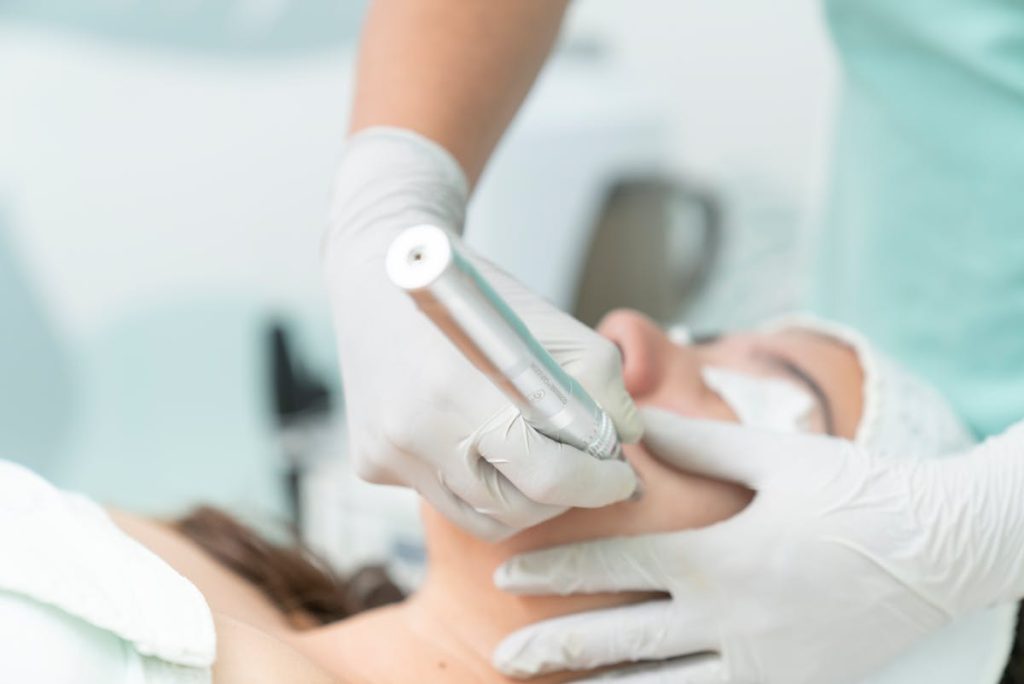
Image: Photo by ANVA Marketing
Topical vs Injectable (The Part Most Articles Skip)
This is the most important section, so I’m going to slow down.
There are two completely different things being called a “salmon sperm facial”:
1. The injectable version. A licensed provider uses fine needles to inject purified PDRN solution into the dermis. This is what Kim got. This is what’s done in Korea, the UK, and parts of Europe under brand names like Rejuran and Nucleofill.
2. The topical version. A clinic uses microneedling (creating tiny channels in the skin) and then applies a PDRN serum on top so it absorbs deeper. Some US clinics offer this. You can also buy PDRN serums and creams at home, with no needles, no clinic, and no appointment.
These are not equivalent. Topical PDRN skincare products are generally safe because the DNA fragments can’t penetrate too deeply into the skin – which is partly why they’re allowed to be sold over the counter. The trade-off is that results are subtle at best compared to in-office treatments.
So when a friend asks me “should I get the salmon sperm facial?”, my first question back is always: which one? Because they cost different amounts, carry different risks, and aren’t even really the same treatment.
If you’ve already decided you want to try the topical version at home, that’s a separate rabbit hole worth going down. I broke down everything I tell my friends about PDRN serums – what’s actually worth buying, how it compares to retinol, and which K-beauty brands deliver the real ingredient – in our PDRN skincare guide.
Is It FDA Approved? (Short Answer: Depends Which Version)
This is the question I get most. Here’s what I always tell friends, and I want you to read it twice because the difference matters.
Topical PDRN skincare (serums, creams, masks): These are sold legally in the US as cosmetics. According to the FDA’s own guidance on cosmetics regulation, cosmetics are regulated but not pre-approved by FDA; color additives are the main exception. Topical PDRN creams and serums fall in this cosmetic category. Cosmetics in the US don’t go through pre-market approval – companies are responsible for the safety of what they sell. PDRN topicals are everywhere right now. They are legal.
Injectable PDRN (the actual “salmon sperm facial” Kim got): Not FDA approved in the US. Rejuran injectable specifically has not received FDA approval for skin booster injection use in the United States, despite being popular and approved in South Korea. In South Korea, Rejuran has obtained regulatory approval from the Ministry of Food and Drug Safety (MFDS) for two indications related to tissue regeneration and nutritional support. But not here.
What does that practically mean? Many American clinics quietly offer these treatments using imported products, but this creates legal and safety risks. Injectable PDRN treatments aren’t regulated by the FDA, meaning quality and sterility aren’t guaranteed. Some US clinics use the workaround of microneedling plus topical PDRN to get a “salmon sperm facial” experience without injecting – that’s a different procedure, and the regulatory category is different too.
I’m not a doctor. I’m not your lawyer. But this is the honest read of where things stand in the US right now: the cream is fine, the injection is in a gray zone.
What It Costs in the US
Friends always ask me about price, and the honest answer is: more than you think, and the range is wide.
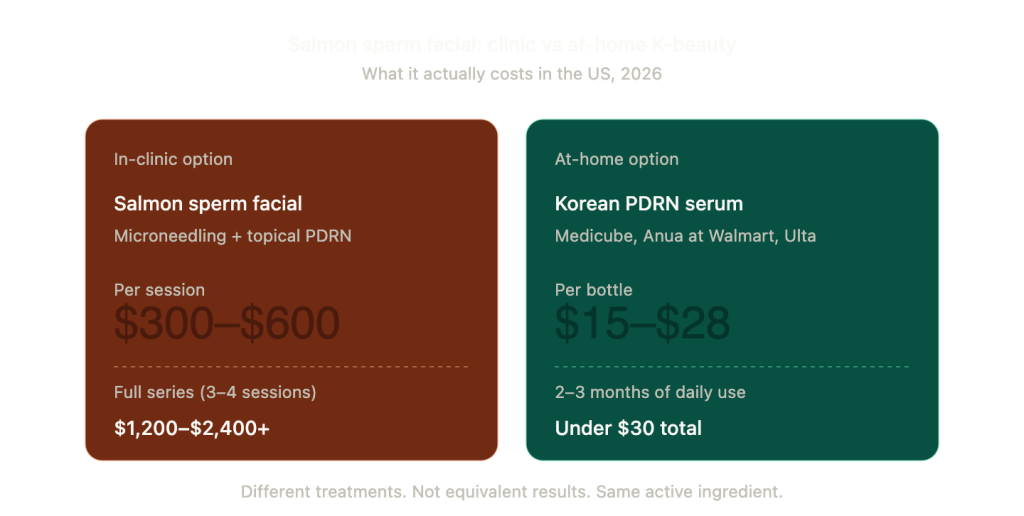
For the in-clinic salmon sperm facial (microneedling plus PDRN topical, the common US version): most clinics charge between $300 and $600 per session. The cost varies based on factors like the clinic’s location, the provider’s reputation, and experience level. Florida clinics typically range from $500 to $800 per session. A high-end NYC or LA clinic can easily push past $1,000.
A few things to know that nobody tells you:
- Most providers recommend 3 to 4 sessions spaced about 4 weeks apart, then maintenance every few months. That’s not optional if you want results – that’s the protocol.
- A full series usually runs $1,200 to $2,400 or more when you do the math. Some clinics quote upward of $4,000 for the full regimen at premium spots.
- Numbing cream sometimes costs extra.
Now compare that to the topical version. A 30ml bottle of Anua’s PDRN Hyaluronic Acid Capsule 100 Serum runs $28 at Ulta. Medicube’s PDRN Pink Peptide Serum (the one Hailey Bieber has talked about) is sold at Walmart for $14.88, regularly $19.97. So a few months of at-home K-beauty PDRN can cost less than one in-office session. Whether the results are equivalent – they aren’t, honestly – but the price comparison is wild.
Is It Safe? What I’d Ask Before Booking
Here’s where I want to be a careful friend, not a hype woman. Salmon sperm facials are not for everyone.
The injectable version, when done in a sterile clinic by someone trained, has a strong safety record in countries where it’s approved. Dr. Mona Gohara, a board-certified dermatologist, gave a comparison that stuck with me: “Any injection or microneedling with biologic material has potential for infection or allergic reaction. Think of it as sushi – fresh and handled properly, fine; mishandled, and you could get very sick.”
Things to genuinely think about:
- Fish allergies. This is the obvious one. Be cautious if you have fish allergies or chronic inflammatory skin conditions such as rosacea or eczema. Some people have reported rashes and flare-ups post-treatment.
- Pregnancy and breastfeeding. Skip it. Talk to your OB. There’s not enough safety data for these populations.
- Active acne, broken skin, recent sunburn. Wait until your skin barrier is calm.
- Provider credentials. Always. Ask if they’re licensed, ask what product they use, ask where it’s sourced.
If a clinic is offering injectable PDRN in the US right now, that’s a conversation I’d want to have very directly before booking. Not because it’s automatically unsafe, but because the regulatory layer is missing, and you have a right to know exactly what’s going into your face.
When in doubt, talk to a board-certified dermatologist. I say that every time, and I’ll say it again here.
The K-Beauty Topicals I Keep Seeing in Friends’ Bathrooms
Most of the people in my life who actually tried PDRN didn’t go to a clinic. They went to YesStyle or Ulta. So this is the honest list of products that keep showing up:
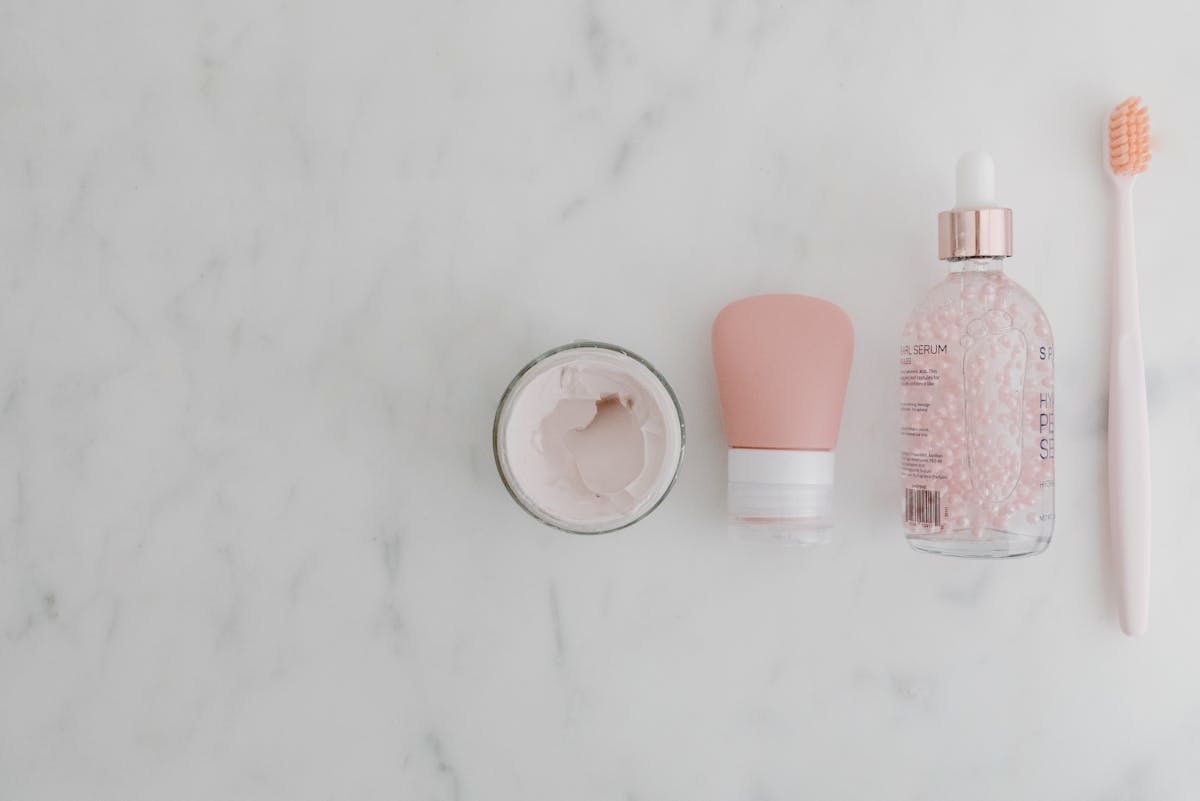
- Medicube PDRN Pink Peptide Serum. The pink one Hailey Bieber has talked about. Powered by 10,000 ppm Salmon PDRN, the serum claims to improve skin firmness and bounce in as little as two weeks. The pink color comes from Vitamin B12, not artificial dye. Around $15 to $20 on Walmart.
- Anua PDRN Hyaluronic Acid Capsule 100 Serum. Currently $28 at Ulta. Combines PDRN with hyaluronic acid and collagen. The brand reports a temporary hydration and moisture plumping effect improved by 8.93% after one use in their internal testing – small numbers, but a clear hydration claim. Friends with normal-to-dry skin like this one.
- Anua PDRN Hyaluronic Acid 100 Moisturizing Cream. A lighter daily moisturizer with the same actives, around $20 at Ulta. Honestly fine if your routine is already crowded – the serum does more.
I want to be transparent: most topical PDRN claims are marketing language. PDRN as a molecule has been shown to improve skin healing and regeneration, boost fibroblast activity, increase collagen stimulation, and reduce inflammation. That’s the generally accepted dermatology view. But how much penetrates your skin from a cosmetic serum is genuinely limited. You’ll get hydration and probably some barrier support. You won’t get clinic-level rejuvenation from a $15 bottle. Manage expectations.
If you want to layer PDRN with your existing routine, I wrote about how niacinamide and hyaluronic acid layer in the routine guide I keep linking friends to. PDRN slots in nicely as a hydrating, repairing layer at the serum step.
A friend of mine has been using the Medicube Pink Peptide Serum for about three months. Her skin looks better, but she also started drinking more water and sleeping more around the same time, so I can’t say it’s all the serum. That’s the honest read.
FAQ
Is the salmon sperm facial FDA approved? The injectable form is not FDA approved in the US for cosmetic use. PDRN injectables have no FDA approval for aesthetic use at this time. Topical PDRN skincare (serums, creams) is sold legally as a cosmetic, which the FDA regulates but doesn’t pre-approve.
How long does a salmon sperm facial last? Many people see an instant glow within days of treatment, but the real results show over the next 4 to 6 weeks as collagen production ramps up. Effects can last 4 to 6 months or longer with proper skincare and maintenance sessions.
How is it different from a regular facial? A regular facial is mostly cleansing, exfoliation, and surface hydration. A salmon sperm facial uses microneedling or injections to deliver PDRN deeper, where it can act on collagen-producing cells. The mechanism is different. So is the price.
Can I just use a PDRN serum at home instead? You can, and many people do. The results are subtler. Topical PDRN is good for hydration, barrier support, and a bit of glow. It won’t replicate clinic-level treatment, but it costs $20 instead of $600.
Is there a vegan version? Yes. For those seeking a sustainable, cruelty-free alternative, vegan plant-based PDRN does exist. They’re extracted from yeast, wheat germ or certain legumes. The science isn’t as established yet, but the products are out there. (I’m working on a separate piece on this – link coming when it publishes.)
The Honest Bottom Line
Here’s what I tell every friend who asks. The salmon sperm facial isn’t a scam, but it isn’t magic either. It’s a real treatment with real (if subtle) science behind it, currently in a regulatory gray zone in the US for the injectable form. If you’re curious and have $600 to spare, find a board-certified provider who can answer every single question about the product they’re using. If you’re curious but not ready for that, start with a $20 K-beauty serum and see how your skin reacts to topical PDRN over six weeks. Either way, manage expectations. None of this turns the clock back ten years. It might turn it back six months, in good light.
If you’re following the wider K-beauty story, I broke down how recent US tariffs and FDA changes are affecting the products you can get over here in the K-beauty tariffs piece. That article explains why some Korean PDRN products are getting harder to find, and what to do about it.
Curious about the broader ingredient story? I’m working on a deeper guide called everything I tell friends about PDRN skincare, which goes into the K-beauty side specifically. It’ll publish next.