If you’ve ever stood in a skincare aisle staring at three niacinamide serums, one labeled 2%, one 5%, and one 10%, wondering which number actually matters, you’re not alone. This is the question I get from friends more than almost any other skincare question, and the answer is both simpler and more nuanced than the packaging suggests.
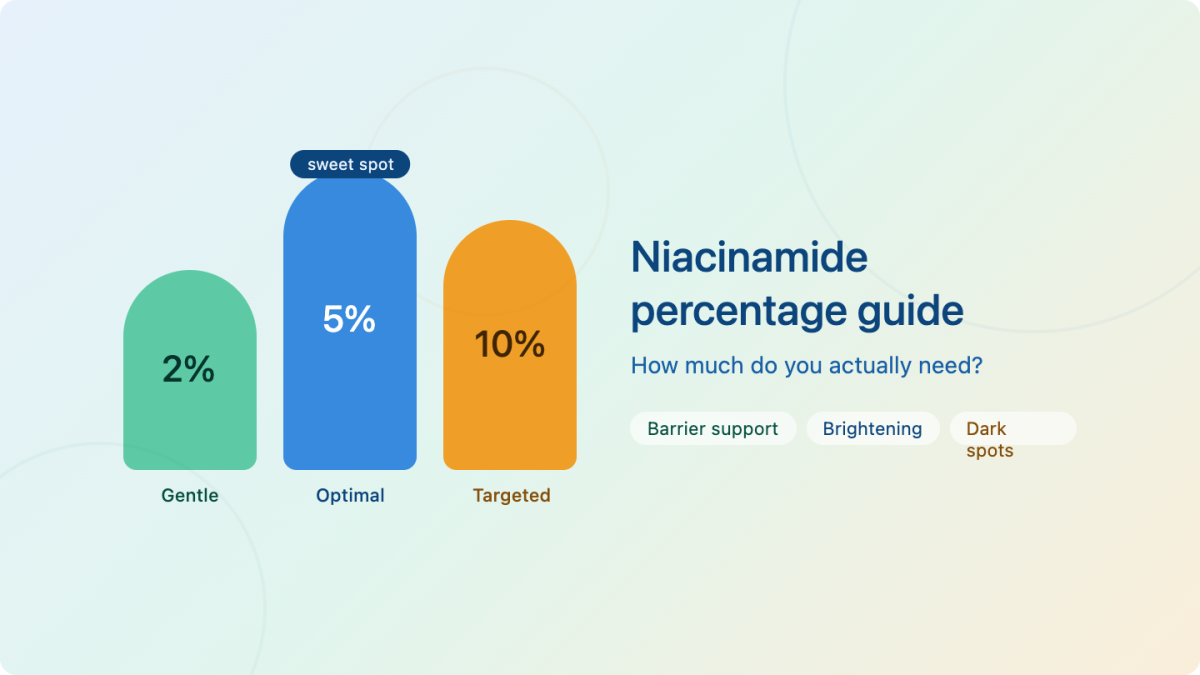
The short version: 4-5% niacinamide is the sweet spot for most people. Most clinical studies showing real benefits were conducted at this concentration. Higher isn’t automatically better. In fact, going too high can actually cause the problems niacinamide is supposed to prevent.
But concentration isn’t the whole story, and there’s a sneaky issue with niacinamide that almost nobody talks about. More on that in a minute.
What Each Concentration Actually Does
2% Niacinamide — The Gentle Foundation
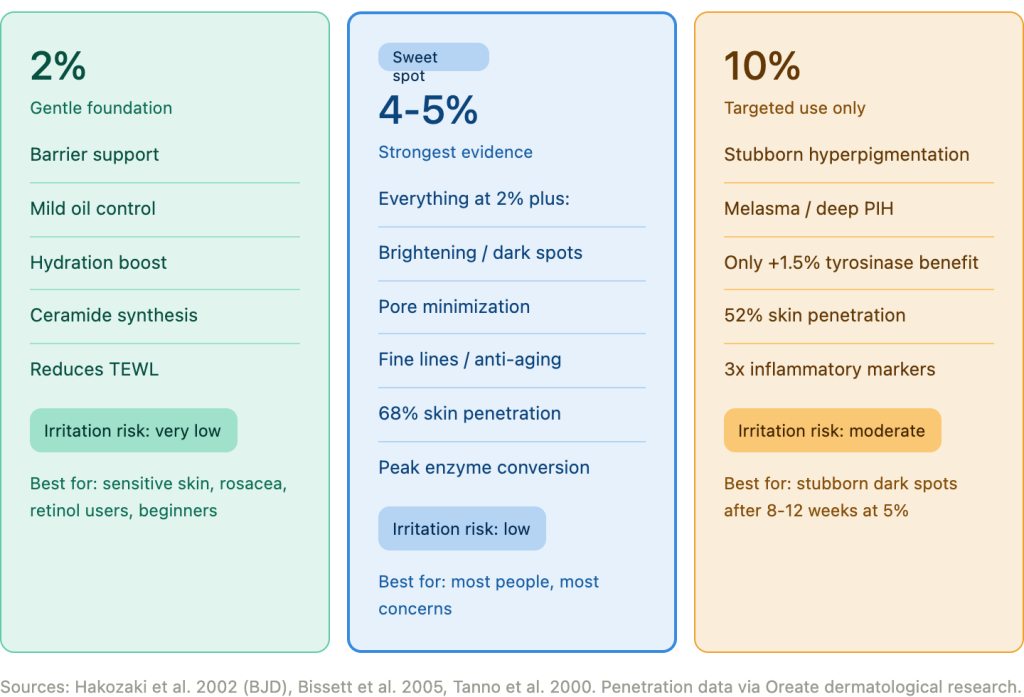
Two percent is where niacinamide starts working, and it works better than most people expect.
A 2006 study published in the Journal of Cosmetic and Laser Therapy found that 2% niacinamide reduced sebum production and visibly shrank pore appearance after just four weeks. Research on ceramide synthesis (the lipids that hold your skin cells together, like mortar between bricks) showed that topical application of 2% niacinamide significantly increased ceramide levels in the outer skin layer and reduced transepidermal water loss in patients with dry skin.
If your main goals are basic barrier support, mild oil control, and hydration, 2% is genuinely enough. It’s what I suggest to friends who are new to active ingredients or who have sensitive skin that reacts to everything. Start here. If you don’t see what you want after 6 to 8 weeks, you can move up.
Best for: Sensitive skin, rosacea-prone skin, retinol users who want gentle barrier support, anyone new to niacinamide.
4-5% Niacinamide — The Sweet Spot
This is where the strongest clinical evidence lives. The majority of peer-reviewed studies demonstrating niacinamide’s benefits on hyperpigmentation, oil control, fine lines, and barrier function were conducted at 4 to 5%.
The landmark Hakozaki et al. study (2002, British Journal of Dermatology) used 5% niacinamide and showed significant reduction in dark spots and suppression of melanosome transfer (the process by which melanin moves into skin cells and causes visible discoloration). A Bissett et al. study (2005) found that 5% niacinamide applied over 12 weeks improved barrier function and visibly reduced wrinkle depth, redness, and sallowness in photoaged skin.
Here’s the part that surprised me when I first learned about it. Research on how niacinamide penetrates the skin found that once concentration hits around 3.2%, the enzymes responsible for converting niacinamide into its active form (NAD+) start working at full capacity. At 5%, the penetration rate into the outermost skin layer (stratum corneum) was measured at about 68%. At 10%, that rate actually dropped to 52% because of stronger molecular interactions at higher concentrations. More molecules trying to get through the door doesn’t mean more get in.
Dr. Ranella Hirsch, a board-certified dermatologist and former president of the American Society for Dermatologic Surgery, has said niacinamide isn’t like retinoids where higher strength often means stronger effects. She notes that pushing beyond 5% rarely translates to deeper penetration and mainly increases the likelihood of irritation.
Best for: Brightening, pore minimization, oil control, fine lines, uneven skin tone, general anti-aging. This is the concentration I suggest to most friends who ask.
If you’re shopping for one, we reviewed the best niacinamide serums for beginners.
10% Niacinamide — When You Might Actually Need It
Ten percent isn’t useless. But it’s narrower in application than the marketing suggests.
The case for 10% is stubborn, established hyperpigmentation that hasn’t responded to 5% after consistent use. Post-inflammatory hyperpigmentation from acne, melasma in deeper skin tones, or sun damage that’s been building for years. These concerns sometimes benefit from the extra concentration.
But the trade-offs are real. Studies comparing 5% and 10% found that the 10% group saw only marginally better results in tyrosinase inhibition (41.2% vs 39.7%), but experienced a threefold increase in inflammatory markers. For some people, that inflammation can trigger post-inflammatory hyperpigmentation, which means the very dark spots you’re trying to treat could get worse.
Ten percent can also cause stinging, redness, and flushing in people with compromised barriers or sensitive skin. These reactions are sometimes mistaken for purging or “the product is working,” when they’re actually signs of irritation.
Best for: Stubborn hyperpigmentation that hasn’t responded to 5% after 8-12 weeks, and only if your skin tolerates it without irritation.
20%+ Niacinamide — Skip This
There is no published clinical evidence showing that concentrations above 10% provide meaningful additional benefits. Multiple dermatologists and cosmetic chemists have stated that anything over 10% is unnecessary and risks barrier damage. The higher the concentration, the greater the irritation potential without a corresponding increase in efficacy.
If a product advertises 15% or 20% niacinamide as a selling point, that’s marketing, not science. Move on.
The Hidden Overdose Problem
This is the thing I wish someone had told me earlier, and it’s the reason I bring it up with practically every friend who mentions niacinamide.
Niacinamide is everywhere now. Your cleanser might have 2%. Your toner might have 3%. Your serum is 5%. Your moisturizer has another 4%. If you’re layering all of these in one routine, you could be applying 14%+ of niacinamide without realizing it. And while niacinamide is gentle at any single-product concentration, the cumulative load on your skin barrier is what causes problems.
Symptoms of niacinamide overload look a lot like the symptoms of a damaged skin barrier: persistent redness, stinging when you apply products that never stung before, tightness, small bumps that aren’t quite acne, or skin that feels irritated for no obvious reason.
If any of that sounds familiar and you use multiple niacinamide products, try this: audit your routine. Check the ingredient list of every product you use on your face. If niacinamide (also listed as nicotinamide) appears in more than two products in the same routine, you’re probably stacking more than your skin needs.
The fix is simple. Pick one niacinamide product per routine, ideally a serum at 4-5%, and let the other products in your routine do other jobs. You don’t need niacinamide in every step.
Signs You’re Using Too Much Niacinamide
If you’re experiencing any of these and you use niacinamide regularly, consider cutting back:
Persistent redness that wasn’t there before. Not the temporary flush some people get when they first start niacinamide (that usually resolves within a week). This is ongoing redness that doesn’t go away.
Stinging or tingling on application. Your skin shouldn’t sting when you apply a product you’ve been using for weeks. If it does, your barrier is telling you something.
Small, texture-like bumps. Often mistaken for breakouts or purging. Niacinamide doesn’t cause purging (it doesn’t increase cell turnover the way retinol does). If you’re getting bumps, it’s likely irritation.
Dryness or tightness despite using a moisturizer. This seems counterintuitive since niacinamide is supposed to improve barrier function. But too much can overwhelm the skin and actually compromise the barrier it’s meant to support.
Increased sensitivity to other products. If your vitamin C serum or retinol suddenly feels harsher than it used to, excess niacinamide may be weakening your barrier.
If you recognize two or more of these, drop your niacinamide concentration to 2% or switch to using it only once daily (morning or evening, not both) for two weeks. If symptoms persist, the Cleveland Clinic’s niacinamide guide covers when to see a dermatologist.
Your Decision Flowchart
What’s your skin type?
If sensitive or easily irritated → Start at 2%, once daily. Reassess after 6 weeks.
If normal or combination → Start at 4-5%, once daily. This is the clinical sweet spot.
If oily or acne-prone → Start at 5%, can use morning and evening. Monitor for irritation.
What’s your main concern?
If barrier repair or hydration → 2% is sufficient. Pair with hyaluronic acid (here’s the correct layering order).
If brightening, pores, or oil control → 4-5% is backed by the strongest evidence.
If stubborn hyperpigmentation (melasma, PIH) → Try 5% for 8-12 weeks first. If insufficient, increase to 10% with careful monitoring.
If general maintenance → 2-5% in one product is all you need. Don’t overthink it.
Layering Niacinamide With Other Actives
Niacinamide plays well with most ingredients, which is partly why it ended up in everything. Here’s how it interacts with the actives you’re most likely using:
With retinol: Apply niacinamide before retinol. The niacinamide strengthens your barrier and reduces retinol irritation. This is one of the best pairings in skincare. A 4-5% niacinamide with retinol is the pairing I recommend most.
With hyaluronic acid: Use both freely. Hyaluronic acid first (on damp skin), then niacinamide. They complement each other: HA pulls in moisture, niacinamide helps your barrier retain it.
With vitamin C: Despite the old myth, these two work fine together with modern formulations. The concern about niacin flush when combining them was based on outdated 1960s research and has been thoroughly debunked. You can use vitamin C in the morning and niacinamide in the evening, or layer them in the same routine.
With AHAs/BHAs (glycolic acid, salicylic acid): Use acids first, wait a few minutes, then apply niacinamide. The niacinamide helps calm any irritation from the acid. However, if you’re acid-sensitive, alternate nights rather than layering in the same routine.
What About Niacinamide in Moisturizers vs Serums?
Serums deliver a targeted, known concentration directly to your skin. If you want to control exactly how much niacinamide you’re using, a serum is the best vehicle.
Moisturizers with niacinamide are fine for general maintenance, especially at 2-4% for people who want the barrier benefits without adding another step. But the concentration in moisturizers is often lower, and because they’re formulated primarily for hydration and occlusion, the niacinamide is diluted among other ingredients.
My recommendation: if niacinamide is a priority for a specific concern (brightening, oil control, hyperpigmentation), use a dedicated serum. If you just want general barrier support, a moisturizer with 2-4% niacinamide is a simple, effective option.
A friend of mine was using a niacinamide cleanser, a niacinamide toner, AND a 10% niacinamide serum for months, complaining her skin felt tight and irritated all the time. I looked at her routine and said “you’re at like 16% niacinamide, that’s not a routine, that’s an assault.” She dropped everything except one 5% serum and her skin calmed down in a week. Sometimes less really is the whole answer.
Frequently Asked Questions
What percentage of niacinamide is best for most people?
4-5% is the sweet spot. The majority of clinical studies showing benefits for brightening, pore size, oil control, and barrier function were conducted at this concentration. It offers the best balance of efficacy and tolerability. Dr. Ranella Hirsch, a board-certified dermatologist, has noted that pushing beyond 5% rarely provides additional benefits and primarily increases irritation risk.
Is 10% niacinamide too much?
Not necessarily, but it’s more than most people need. Research shows only marginal improvement in results between 5% and 10%, with a threefold increase in inflammatory markers at 10%. For most concerns, 5% is equally effective. Reserve 10% for stubborn hyperpigmentation that hasn’t responded to 5% after 8-12 weeks of consistent use, and only if your skin tolerates it without redness or stinging.
Can you use too much niacinamide?
Yes. While niacinamide is gentle at any single-product concentration, stacking multiple niacinamide products (cleanser + toner + serum + moisturizer) can push your total cumulative percentage well above 10%, potentially causing redness, stinging, texture bumps, and barrier damage. Audit your routine and limit niacinamide to one or two products per routine.
Should I use niacinamide in a serum or moisturizer?
Serum if niacinamide is addressing a specific concern (brightening, oil control, hyperpigmentation), since serums deliver a known, targeted concentration. Moisturizer if you want general barrier support without adding another step, ideally at 2-4%.
How long does niacinamide take to work?
Most clinical studies show visible results at 4-8 weeks with consistent use. Barrier improvements can appear within 2-4 weeks. Hyperpigmentation typically takes 8-12 weeks. If you don’t see results after 12 weeks at 5%, consult a dermatologist before increasing concentration.
This article is for informational purposes only and is not professional skincare advice. Everyone’s skin is different. If you have specific skin conditions or concerns about niacinamide concentration, consult a dermatologist.